
05-29-2026
Understanding earthmoving equipment is fundamental for anyone working in construction, mining, infrastructure development, or large-scale land preparation. These machines are engineered specifically to move, excavate, grade, and transport massive volumes of soil, rock, and debris with precision and efficiency that no manual workforce could replicate. Whether you are planning a road construction project, a commercial building foundation, or a large excavation job, knowing what earthmoving equipment is and how each machine category contributes to the workflow allows for smarter planning, better resource allocation, and safer site operations.
The term earthmoving equipment covers a broad family of heavy machines, each with a distinct mechanical function, operational role, and site application. From excavators that dig deep into the ground to bulldozers that reshape terrain and motor graders that finish road surfaces, this category of machinery forms the backbone of virtually every civil engineering and construction project worldwide. In this article, we break down the core definition of earthmoving equipment, explain the major machine types and their working mechanisms, and describe how these machines function collectively on active job sites.
Earthmoving equipment refers to any heavy-duty machine designed to manipulate large quantities of earth, rock, sand, or similar materials during site preparation, excavation, grading, or material transport. The primary objective is to reshape the natural terrain to meet engineering specifications — whether that means digging below grade, pushing material across a site, loading trucks, or compacting a sub-base layer. Without this class of machinery, nearly every modern infrastructure project would be technically or economically unfeasible at the required scale.
The defining characteristic of earthmoving equipment is the power-to-capacity ratio. These machines are built around high-torque engines, robust hydraulic systems, and reinforced undercarriages that allow them to exert enormous force on resistant materials while maintaining control and reliability over extended work cycles. A single large excavator, for example, can move hundreds of tons of material in a single shift — output that would require dozens of workers and days of manual labor to replicate.
From a project management perspective, earthmoving equipment selection directly affects project timelines, ground-breaking costs, and site safety outcomes. Matching the right machine type to each phase of the job is not simply about capability — it is about operational efficiency, fuel consumption, ground pressure management, and the sequencing of tasks across a multi-phase site.
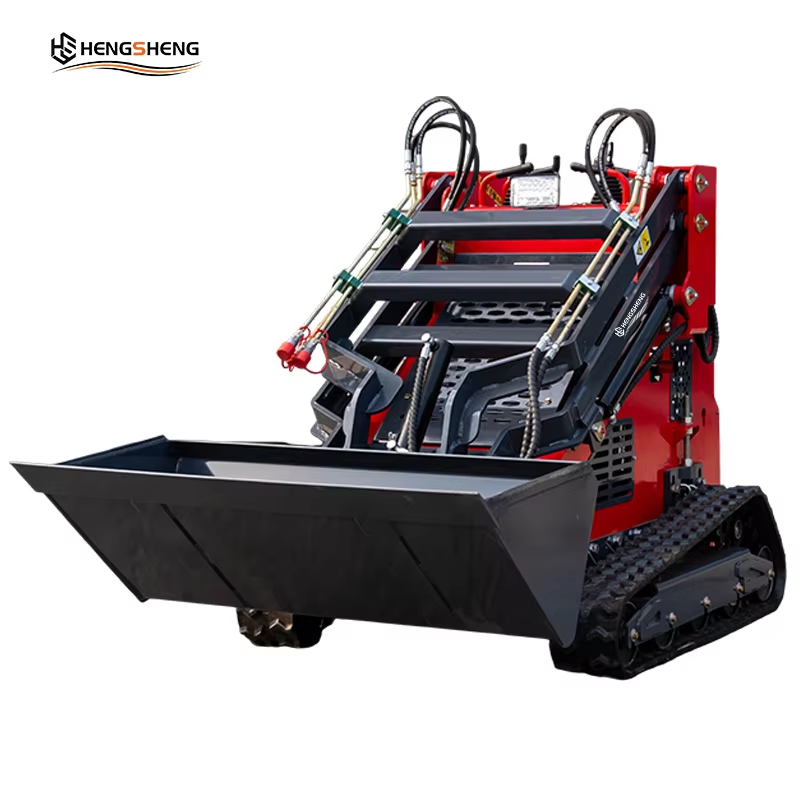
Earthmoving equipment is broadly categorized according to its primary function: excavating and digging, pushing and grading, loading and hauling, or compacting. While there is some functional overlap — a skid steer loader, for instance, can both load and push — most machines are purpose-engineered for a dominant task. This categorical thinking helps site supervisors and project engineers structure their equipment fleets around workflow logic rather than simply accumulating machinery.
The size and weight class of earthmoving equipment also matters significantly. Mini excavators and compact track loaders are suited to confined urban sites or smaller excavation tasks, while large hydraulic excavators and articulated dump trucks are deployed on open mine sites, highway projects, and major earthworks. Understanding the scale dimension of the equipment category helps buyers and rental managers match machines to site conditions without over-specifying or under-powering the fleet.
The hydraulic excavator is arguably the most iconic and versatile form of earthmoving equipment on any job site. It consists of a rotating upper structure called the house, mounted on a tracked or wheeled undercarriage, with a multi-jointed arm system that connects to a digging bucket. Hydraulic cylinders powered by a central pump system extend and retract the boom, arm, and bucket to dig into the earth, scoop material, and swing it to a desired deposit point — all within a single operator-controlled sequence.
Modern hydraulic excavators used as earthmoving equipment are available in a wide range of operating weights, from compact 1.5-ton models to ultra-large machines exceeding 100 tons. The earthmoving equipment in the large excavator class — typically 30 tons and above — is specifically engineered for deep trench work, mass excavation, and demanding rock-breaking applications where bucket force and hydraulic flow rates must consistently meet high-load requirements. The efficiency of a hydraulic excavator on a job site depends on swing cycle times, bucket fill factors, and the travel distance between dig zone and dump zone.
Excavators also accept a range of attachments — hydraulic hammers, compactor plates, augers, and grapples — which transform them into multipurpose earthmoving and demolition platforms. This adaptability is one reason the hydraulic excavator has become the reference machine for nearly all forms of earthmoving equipment procurement planning.
Bulldozers are tracked earthmoving equipment platforms equipped with a wide, hydraulically controlled front blade used to push material across a surface. The blade can be angled, tilted, or raised and lowered to control how aggressively the machine engages the ground. As the bulldozer advances, the blade acts as a wedge, shearing material from the surface and pushing it forward — a process known as dozing. This makes bulldozers ideal for site clearing, rough grading, and stockpile formation.
The tracked undercarriage of a bulldozer distributes the machine's weight over a large ground contact area, giving it exceptional traction on soft, wet, or uneven terrain — conditions where wheeled earthmoving equipment would struggle. Larger bulldozer models are also fitted with rear-mounted rippers, which are multi-tine shanks hydraulically pressed into compacted soil or soft rock to fracture and loosen the material before the blade pushes it clear. This ripping-then-dozing sequence is a standard workflow in heavy land clearing and hard-ground preparation tasks.
Wheel loaders represent a different operational logic within earthmoving equipment fleets. Rather than cutting into undisturbed ground like an excavator or reshaping terrain like a bulldozer, wheel loaders are optimized for scooping loose or broken material from a pile and transferring it into trucks, hoppers, or stockpile zones. The articulated steering system allows the machine to execute tight loading cycles in compact loading areas, making it a highly productive asset in quarry, aggregate, and construction site contexts.
The working cycle of a wheel loader as earthmoving equipment follows a simple but efficiency-critical pattern: approach the material pile at speed, push the bucket in and crowd it to fill, raise the boom, reverse and pivot, drive to the dump point, tilt the bucket to release, and return. Minimizing this cycle time — through operator technique, machine positioning, and haul road design — is the primary productivity lever for wheel loader deployment. Larger wheel loaders, with bucket capacities above 5 cubic meters, are common in high-volume aggregate and mining operations.
A job site deploying earthmoving equipment is not a collection of independently operating machines. It is a coordinated system where each machine type plays a defined role in a sequential workflow. Typically, site clearing begins with bulldozers removing vegetation and stripping topsoil. Excavators then open trenches or perform bulk excavation. Wheel loaders and articulated dump trucks haul away the excavated material. Motor graders establish the required grades on access roads and building pads, and compactors consolidate the prepared subgrade before construction begins.
The coordination of earthmoving equipment on a complex job site requires careful production matching — ensuring that the output capacity of excavating machines aligns with the hauling capacity of trucks and the throughput of dumping zones. When this balance is lost, bottlenecks form: excavators idle waiting for trucks, or trucks queue waiting for loading time. Experienced site managers use cycle time data, fuel consumption monitoring, and daily production reports to continuously adjust machine deployment and shift scheduling to maintain optimal flow.
One of the most technically important factors governing earthmoving equipment performance on a job site is the nature of the ground itself. Soil classification — ranging from soft clay to dense gravel, weathered rock, or solid bedrock — directly determines which machines can operate effectively and what attachments or methods are required. Sandy soils may require tracked earthmoving equipment to prevent sinking, while cohesive clay soils demand high bucket breakout forces and may need ripping before bulk excavation.
Slope gradient is another critical factor. Earthmoving equipment operating on steep terrain faces stability risks and elevated drive system stress that affect both safety and machine longevity. Most equipment manufacturers specify maximum gradeability ratings, and exceeding these limits — particularly with heavy hauling machines — creates unacceptable rollover or brake failure risk. Site planning for earthmoving equipment deployment therefore always includes geotechnical analysis and slope management planning as integral components of the site logistics model.
The productivity and safety of earthmoving equipment on a job site are inseparable from operator competency. Modern excavators, loaders, and bulldozers incorporate sophisticated electronic control systems, including load management sensors, grade control integration, and telematics platforms that feed real-time performance data to site managers. However, these systems augment rather than replace the skilled judgment of a trained operator who understands soil behavior, machine limits, and site conditions from direct experience.
Training certification for earthmoving equipment operators is a legal requirement in most jurisdictions, and certification levels are generally tiered by machine class and operating weight. An operator qualified for a compact excavator may not be certified to operate a large hydraulic machine, and mismatches between operator qualification and machine class are a common contributing factor in site accidents. Investing in continuous operator development and machine-specific familiarization is therefore not just a compliance obligation — it is a direct productivity and risk management strategy.
Unplanned downtime is the single greatest productivity killer in earthmoving equipment operations. A large hydraulic excavator or wheel loader sitting idle for a day due to a preventable mechanical failure can cost a project thousands in lost production and extended rental or ownership costs. Preventive maintenance — including daily pre-shift inspections, fluid analysis, undercarriage checks, and hydraulic system monitoring — is the operational backbone of high-availability earthmoving equipment fleet management.
Modern earthmoving equipment is increasingly equipped with onboard telematics systems that track engine hours, fault codes, fuel consumption, and component wear trends. This data enables condition-based maintenance planning, where service intervals are triggered by actual machine usage data rather than fixed calendar schedules. Fleet operators who adopt this approach typically achieve measurably higher machine availability rates, lower total maintenance costs, and better alignment between equipment service schedules and project phase timelines.
Earthmoving equipment is a subset of construction equipment specifically designed to move, excavate, grade, or transport earth, soil, rock, and related materials. Construction equipment is a broader category that also includes concrete equipment, lifting and hoisting machinery, paving equipment, and finishing tools. All earthmoving equipment is construction equipment, but not all construction equipment qualifies as earthmoving equipment.
Selecting the right size of earthmoving equipment depends on the volume of material to be moved, the site access constraints, the ground conditions, and the project timeline. Larger machines offer higher production rates but require more space to maneuver, higher transport costs, and greater ground bearing pressure management. A geotechnical assessment combined with a production quantity survey is the recommended starting point for any size selection decision in earthmoving equipment procurement or rental planning.
Fuel consumption in earthmoving equipment is driven primarily by engine load factor, which reflects how hard the machine is working relative to its rated capacity. Ground resistance, material density, haul distance, cycle time efficiency, and idle time all contribute to the overall fuel consumption profile. Site managers who optimize equipment positioning, reduce idle periods, and match machine class to task severity consistently achieve better fuel efficiency across their earthmoving equipment fleets.
Yes, earthmoving equipment is routinely deployed in urban and confined environments, but it requires careful machine selection and site planning. Compact excavators, mini wheel loaders, and skid steer machines are specifically designed for restricted-access jobs where standard-size earthmoving equipment cannot operate safely or practically. In densely built areas, considerations such as overhead clearance, utility line proximity, vibration impact on adjacent structures, and noise regulations must all be integrated into the equipment deployment plan.

 EN
EN