
05-26-2026
The engineering construction machinery industry is undergoing one of its most transformative periods in decades. Driven by rapid urbanization, infrastructure investment surges, and the relentless push for technological innovation, the sector is redefining how projects are planned, executed, and completed. Understanding the key trends shaping engineering construction machinery today is not merely an academic exercise — it is a business-critical necessity for contractors, fleet managers, procurement specialists, and project developers who need to stay competitive in an increasingly demanding market.
From electrification and autonomous operation to data-driven fleet management and sustainability mandates, the forces reshaping engineering construction machinery are complex and interconnected. This article explores the most significant trends influencing the industry right now, offering practical insight into what these shifts mean for businesses that rely on heavy equipment to deliver infrastructure outcomes. Whether you are evaluating new machine acquisitions, reconsidering maintenance strategies, or planning long-term capital investments, these trends will directly affect your decisions.
For generations, diesel engines have been the backbone of engineering construction machinery. They deliver the torque, power density, and fuel availability that demanding jobsite conditions require. However, tightening emissions regulations across major markets — including Euro Stage V standards in Europe and Tier 4 Final requirements in North America — are compelling manufacturers and operators to seriously explore alternative power sources. The transition is not happening overnight, but its direction is unmistakable.
Battery-electric excavators, wheel loaders, and compact construction equipment are entering commercial availability at an accelerating pace. These machines offer meaningful advantages beyond emissions compliance: reduced noise pollution, lower operating costs in markets where electricity is competitively priced, and the ability to work in enclosed or environmentally sensitive areas where diesel exhaust is prohibited. For operators managing urban tunneling, indoor demolition, or projects near sensitive ecological zones, electric-powered engineering construction machinery opens doors that were previously closed.
Hydrogen fuel cell technology is also attracting serious investment as a potential solution for high-power applications where battery weight and charging time create practical limitations. While large-scale deployment of hydrogen-powered engineering construction machinery remains several years away from mainstream adoption, pilot programs and prototype machines are demonstrating viable performance, indicating that the industry is actively exploring every available pathway to decarbonization.
For many fleet operators, fully electric engineering construction machinery still presents challenges related to battery range, charging infrastructure, and upfront cost premiums. Hybrid powertrains — combining conventional diesel engines with electric motor-assist systems — represent a pragmatic middle ground that delivers immediate fuel savings and emissions reductions without requiring complete infrastructure overhaul. Hybrid excavators and cranes have demonstrated fuel efficiency improvements of 20 to 40 percent in real-world applications, making the financial case increasingly compelling.
The adoption of hybrid systems in engineering construction machinery is particularly strong in markets where carbon taxation or fuel levies add significant cost to diesel operation. As these regulatory pressures intensify globally, hybrid solutions are expected to capture a growing share of new equipment orders, especially in medium-to-large machine categories where the economic payback period for the hybrid premium is shortest.
Modern engineering construction machinery is increasingly equipped with sophisticated telematics systems that continuously transmit operational data — engine hours, fuel consumption, hydraulic system performance, GPS location, idle time, and fault codes — to cloud-based fleet management platforms. This real-time visibility transforms how fleet managers make decisions, shifting from reactive maintenance schedules to predictive, data-driven service interventions that prevent costly unplanned downtime.
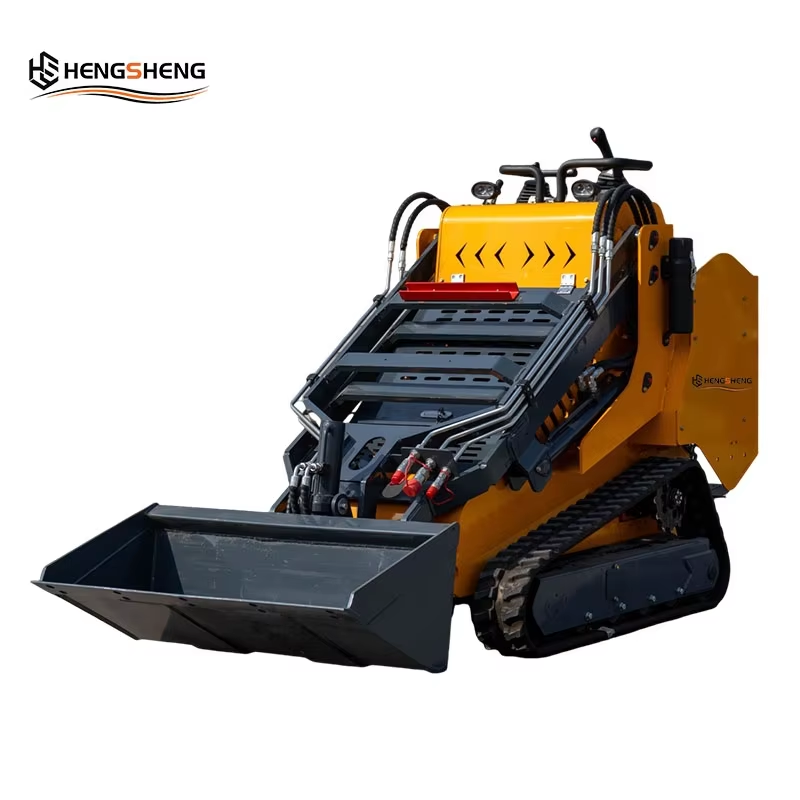
For large construction enterprises managing dozens or hundreds of machines across multiple project sites, telematics integration in engineering construction machinery delivers measurable financial returns. Identifying machines with excessive idle time, optimizing equipment deployment across sites, and catching early-stage mechanical issues before they escalate into major failures are all made possible when machines communicate their status continuously. The data layer is becoming as important as the mechanical layer in evaluating machine value.
Advanced telematics platforms are also integrating with broader project management software ecosystems, connecting machine performance data with schedule milestones, earthwork quantity tracking, and procurement systems. This integration is turning engineering construction machinery into active contributors to digital project delivery rather than passive tools that simply execute physical work.
Grade control and machine guidance systems have matured from niche premium options to near-standard features on productive jobsites. GPS-based grading systems on bulldozers, motor graders, and excavators eliminate the need for manual grade stakes, reduce rework, and accelerate earthwork completion timelines significantly. These machine control technologies represent one of the most impactful productivity improvements in engineering construction machinery in recent memory, and their adoption rate continues to climb.
Beyond semi-autonomous operation, fully autonomous engineering construction machinery is transitioning from research environments to operational deployment in specific high-value applications. Autonomous hauling systems in large open-pit mining and quarry operations have logged millions of operating hours, demonstrating the reliability and safety case for removing human operators from cabs. While fully autonomous operation in complex, dynamic construction environments remains technically challenging, the trajectory is clear: automation will progressively expand across machine categories and application types.
The sustainability agenda is reshaping procurement decisions for engineering construction machinery at an accelerating pace. Large infrastructure project owners — including government agencies, institutional investors, and multinational corporations — are increasingly embedding carbon footprint requirements into tender specifications and contractor qualification criteria. Contractors who cannot demonstrate credible plans to reduce the emissions intensity of their plant and equipment are finding themselves at a competitive disadvantage in high-value procurement processes.
This trend is driving fleet renewal decisions across the engineering construction machinery market, as operators prioritize newer, cleaner, and more fuel-efficient machines not just for operational cost reasons but to satisfy client sustainability expectations. The ability to report verified fuel consumption and emissions data — enabled by telematics systems — is becoming a commercial asset rather than simply an internal management tool.
Circular economy principles are influencing how businesses think about the full lifecycle of engineering construction machinery. Rather than viewing heavy equipment as assets to be replaced on fixed schedules, progressive operators are evaluating the economics of major component rebuilds — engine overhauls, hydraulic pump replacements, undercarriage refurbishment — as an alternative to new machine acquisition. When done correctly with high-quality components, rebuilds can restore machine performance to near-new levels at a fraction of replacement cost while significantly reducing the environmental impact associated with manufacturing new equipment.
The market for rebuilt and remanufactured components for engineering construction machinery is growing as a result, with established supply chains developing around core exchange programs for engines, transmissions, and hydraulic components. This shift reflects a broader maturation in how sophisticated operators value and manage their equipment assets, treating heavy machines as long-term investments to be carefully stewarded rather than consumable items to be cycled through on arbitrary timetables.
The demand outlook for engineering construction machinery is fundamentally shaped by the scale and timing of infrastructure investment programs around the world. Major economies continue to commit substantial public capital to road networks, bridges, rail systems, port expansions, energy infrastructure, and water management projects, creating sustained demand for heavy equipment across a broad range of machine categories. Understanding where these investment cycles are in their trajectory helps fleet operators and equipment businesses anticipate demand patterns and plan accordingly.
Energy transition infrastructure — wind farms, solar installations, grid upgrades, and electrification networks — represents a particularly dynamic growth segment for engineering construction machinery. The physical construction of renewable energy assets requires enormous quantities of earthmoving, material handling, and lifting equipment, creating new demand pools that partially offset cyclical softness in traditional construction markets. This diversification of demand sources is providing greater stability to the engineering construction machinery market than historical patterns might suggest.
The disruptions experienced across global supply chains in recent years have prompted manufacturers and dealers in the engineering construction machinery sector to fundamentally reconsider sourcing strategies and inventory management approaches. Extended lead times, component shortages, and logistics bottlenecks created significant delivery delays that damaged project schedules and strained customer relationships. In response, the industry is investing in supply chain diversification, regional parts stocking, and closer supplier relationships to build resilience against future disruptions.
For buyers of engineering construction machinery, these dynamics have practical implications for equipment availability, delivery timelines, and after-sales parts support. Working with suppliers and dealers who have invested in supply chain resilience and who maintain adequate regional parts inventories has become an important consideration in equipment procurement decisions, particularly for operators managing time-critical project commitments. Products like the engineering construction machinery offered by specialized manufacturers with strong supply chain infrastructure represent exactly the kind of reliable asset that project-focused operators need to evaluate carefully.
As engineering construction machinery becomes increasingly sophisticated — equipped with digital displays, machine control systems, telematics interfaces, and diagnostic tools — the skill profile required of effective operators is evolving significantly. Traditional mechanical intuition and physical machine control remain valuable, but they must now be complemented by digital literacy, data interpretation ability, and comfort with software-driven machine interfaces. Attracting and developing this hybrid skill profile is one of the most pressing workforce challenges facing the construction and mining sectors today.
Training programs for engineering construction machinery operators are adapting in response, incorporating simulation-based learning, digital tool familiarization, and structured competency frameworks that address both the physical and cognitive dimensions of modern machine operation. Simulator-based training, in particular, is gaining traction because it allows operators to build proficiency on complex machine configurations without consuming fuel, incurring wear on productive assets, or exposing trainees to jobsite safety risks during the learning phase.
Remote control and remote operation technologies are emerging as significant developments in engineering construction machinery, driven partly by safety imperatives and partly by the practical need to operate equipment in environments that are hazardous or inaccessible to human operators. Demolition applications, underground mining, nuclear decommissioning, and disaster response scenarios are all driving investment in remote-controlled engineering construction machinery that allows skilled operators to direct machine movements from safe distances using cameras, sensors, and control interfaces.
Beyond hazardous applications, remote operation technology is being explored as a potential solution to geographic labor constraints — allowing a skilled operator based in one location to control engineering construction machinery operating on a project site in a different region. While latency, connectivity reliability, and regulatory frameworks still present barriers to widespread deployment, the underlying technology is maturing rapidly, and early commercial applications are already demonstrating operational viability in controlled conditions.
The primary drivers of electrification in engineering construction machinery are tightening emissions regulations, growing sustainability requirements from project owners and governments, and improving battery technology that is progressively closing the performance gap with diesel powertrains. In addition, operating cost advantages in markets with competitive electricity pricing, combined with the ability to work in noise-sensitive or emissions-restricted environments, are making electric-powered equipment increasingly practical for a wider range of applications.
Telematics systems equip engineering construction machinery with the ability to transmit real-time operational data — including location, utilization, fuel consumption, fault codes, and health metrics — to cloud-based management platforms. This enables fleet managers to move from reactive maintenance approaches to predictive service strategies, reduce costly unplanned downtime, optimize equipment deployment across project sites, and generate verified performance data for carbon reporting and client transparency purposes.
Recent global supply chain disruptions have created extended lead times and parts availability challenges across the engineering construction machinery sector. In response, buyers are prioritizing suppliers with diversified supply chains, strong regional parts inventory, and demonstrated after-sales support infrastructure. Early procurement planning, longer forward ordering horizons, and closer dealer relationships have all become essential strategies for managing equipment availability risk in project-driven operating environments.
As engineering construction machinery integrates more advanced digital technologies — including machine control systems, telematics platforms, and automated operational features — operators must develop a broader skill set that combines traditional mechanical knowledge with digital proficiency. Companies that invest in structured training programs, including simulation-based learning, are better positioned to fully utilize the productivity potential of modern equipment and to attract and retain skilled operators in a competitive labor market.

 EN
EN